19 Small Entryway Ideas That Stop the Pile by the Door


Every home has one spot where shoes, keys, and the day’s mail land the second you walk in. In a small entry, that spot is usually the floor.
A tight entry rarely gets messy because of its size. It gets messy because nothing has a home. A narrow hall or a scrap of wall by the door can hold a surprising amount once every piece has a job. A shelf with hooks screwed underneath. A bench on thin legs. A cabinet barely deeper than a shoe.
These small entryway ideas all come from real homes with real space limits. You’ll find a three-hook corner you can set up in an afternoon, a tip-out shoe cabinet tucked into a chocolate brown nook, a stroller hanging on the back of an apartment door, and a long, skinny hallway lined end to end without squeezing the walkway.
Each idea comes with the details that make it work, plus a quick visual so you can copy just the parts that fit your space. Pick one, try it this weekend, and notice how much calmer it feels to walk in the door.
How to Plan a Small Entryway Before You Buy Anything
Two minutes with a tape measure can save you a return trip. Before you pick a single piece, figure out what your entry has to hold and how much room you really have to hold it.
- Mark the door swings. Open every door all the way and tape its path on the floor. Nothing goes inside those lines.
- List what lands by the door. Shoes, coats, bags, keys, mail, pet gear. Count the people who use the entry, too.
- Measure depth before width. You need room to walk past, so shallow pieces usually beat wide ones.
- Go up before you go out. Hooks, shelves, and wall rails use space the floor never will.
- Give the small stuff one home. A bowl, a drawer, or a tiny key board ends the daily hunt.
1. Pick a Slim Console With a Slatted Shoe Shelf Underneath

Two levels of storage, one narrow footprint, and nothing sticking out into the path of the door.
- Small drawers on top catch keys, sunglasses, and the spare charger. Two little drawers keep things sorted better than one deep one.
- A slatted bottom shelf holds the shoes you wear every day plus your go-to bag. The gaps let grit fall through and air move, so sneakers dry out instead of sitting damp.
- A wood top on a white base hides small scuffs and water marks better than a painted top.
- A basket on the floor beside it takes the overflow, like a throw or a hoodie that never made it upstairs.
Keep the top light. A vase of greenery, a short stack of books, and a clear spot to drop the mail is plenty.
2. Hide a Pile of Shoes in a Shallow Tip-Out Cabinet
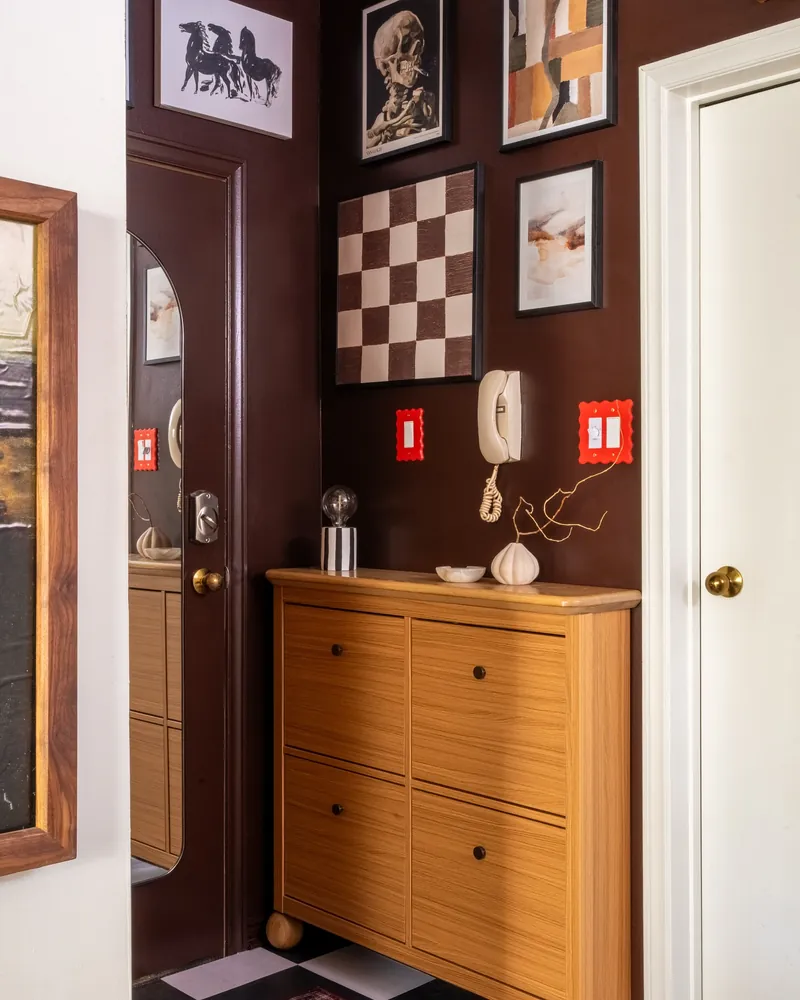
Shoe racks show everything. In a tiny entry, that heap of sneakers is the first thing anyone sees.
The fix in this chocolate brown corner is a slim wood cabinet with flip-down bins. Shoes stand on their heels inside, so the cabinet stays shallow enough to fit where a regular console never could. The top turns into a small landing spot for a lamp, a dish for rings, and a little vase.
Two more space savers here. The mirror hangs right on the door, so it uses zero wall space. And the round feet lift the cabinet just enough to sweep underneath.
| Open shoe rack | Tip-out cabinet |
|---|---|
| Every pair is on display | Closed fronts look tidy |
| Shoes lie flat, so it runs deeper | Shoes stand upright, so it stays shallow |
| Often no useful top | Top doubles as a key and decor ledge |
| Lots of airflow | Less airflow, so dry wet shoes first |
Let rainy-day boots dry on a mat before they go in. Closed bins hold onto moisture.
3. Bridge Two Wall-Mounted Shoe Cabinets With One Long Wood Top
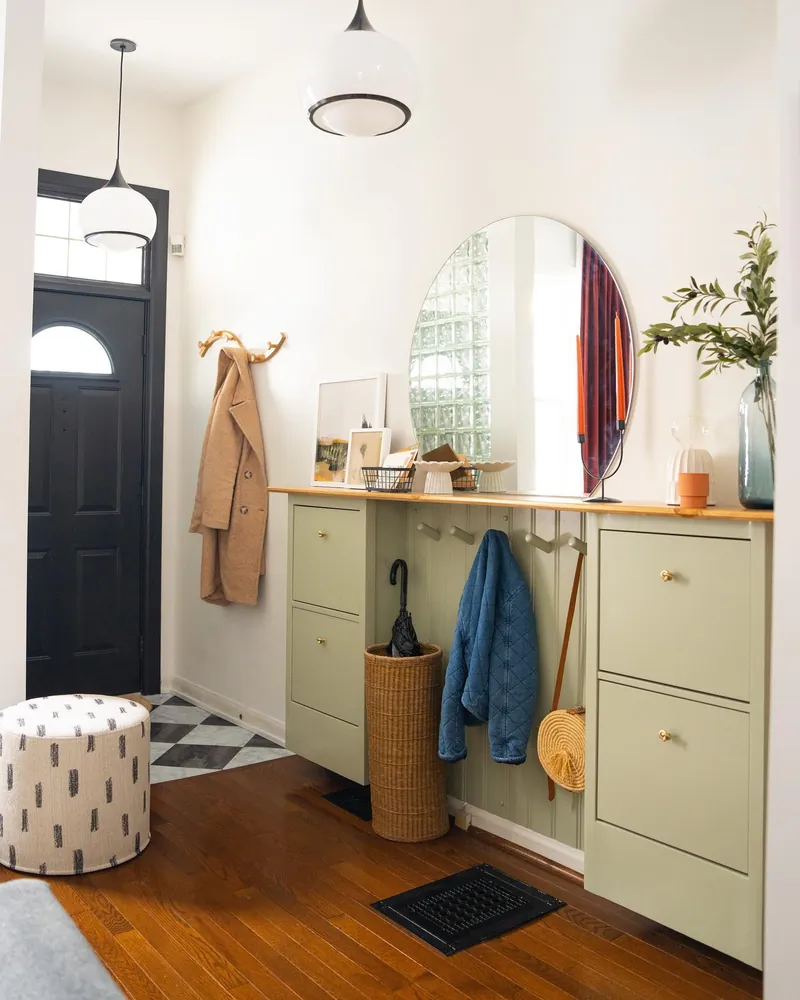
Here’s a built-in look made from simple parts. Two sage green shoe cabinets hang on the wall, a beadboard panel fills the gap between them, and one long wood plank runs across the whole thing.
Floating the cabinets keeps the floor open. The entry feels bigger, you can clean underneath, and the floor vent stays clear. The middle gap pulls its weight too, with wooden pegs for a jacket and a bag, plus a tall rattan basket standing in as an umbrella holder.
Measure the wall and pick two cabinets that leave room for a coat to hang between them.
Anchor both cabinets into studs at the same height, high enough to sweep below.
Fill the gap with a beadboard panel and add a short row of wooden pegs.
Cut one wood plank to span everything and fix it on top.
Paint cabinets and panel one color, then lean a large mirror on the plank.
That single paint color is the trick. Cabinets, panel, and pegs in one shade read as one piece of furniture.
4. Plan the Corner Around Every Door That Swings
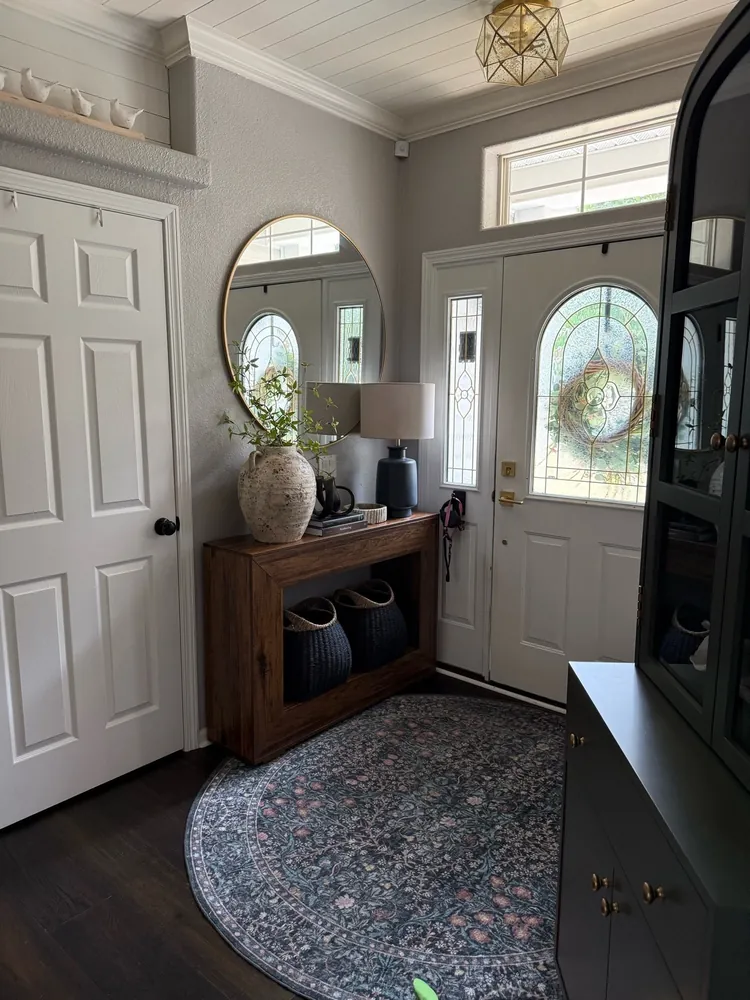
Small foyers often have more doors than wall. This one has a front door, a closet door, and a tall cabinet all meeting in one corner, and it still works. Here’s why.
The rug is round. A low circle fills the landing without sharp corners poking into the closet door’s path.
The console sits on the one free wall. It stays clear of both door swings. Its open base holds two dark woven baskets that hide gloves, mail, and dog gear without looking messy.
A lamp handles late arrivals. Click it on and you can find your keys without flooding the room with overhead light.
The leash hangs by the door. A small hook on the frame keeps it right where your hand goes on the way out.
The tall cabinet takes the bulk. Glass doors up top, closed storage below, all of it going up instead of out.
Open every door all the way before you place any furniture.
Pick a flat, low rug the door can glide over.
A thick rug that catches under the door.
A console that stops the closet from opening fully.
5. Swap the Console for a Tiny Two-Tier Table and Lidded Boxes
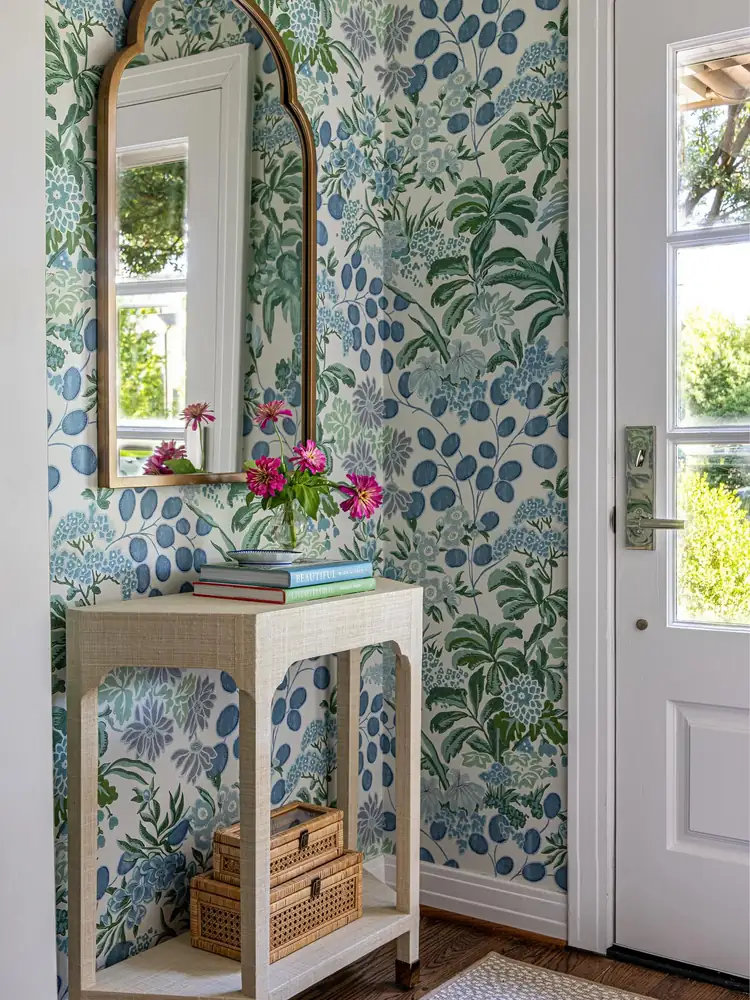
No room for a console? A small square side table can do most of the same work in far less space.
What makes this little corner work so hard:
- The table has two levels. Books and fresh flowers sit up top, storage lives below.
- Two stacked cane boxes fill the lower shelf. The lids keep mail, dog bags, and spare keys out of sight.
- A tall arched mirror covers the wall above, so the spot feels bigger and you get one last look before you head out.
- Bold blue and green botanical wallpaper makes one small wall feel finished, so the table never looks lonely.
The table has a woven wrap instead of a glossy finish, which hides fingerprints and bumps from bags much better.
6. Mount a Swing-Arm Sconce and Keep Every Surface Free
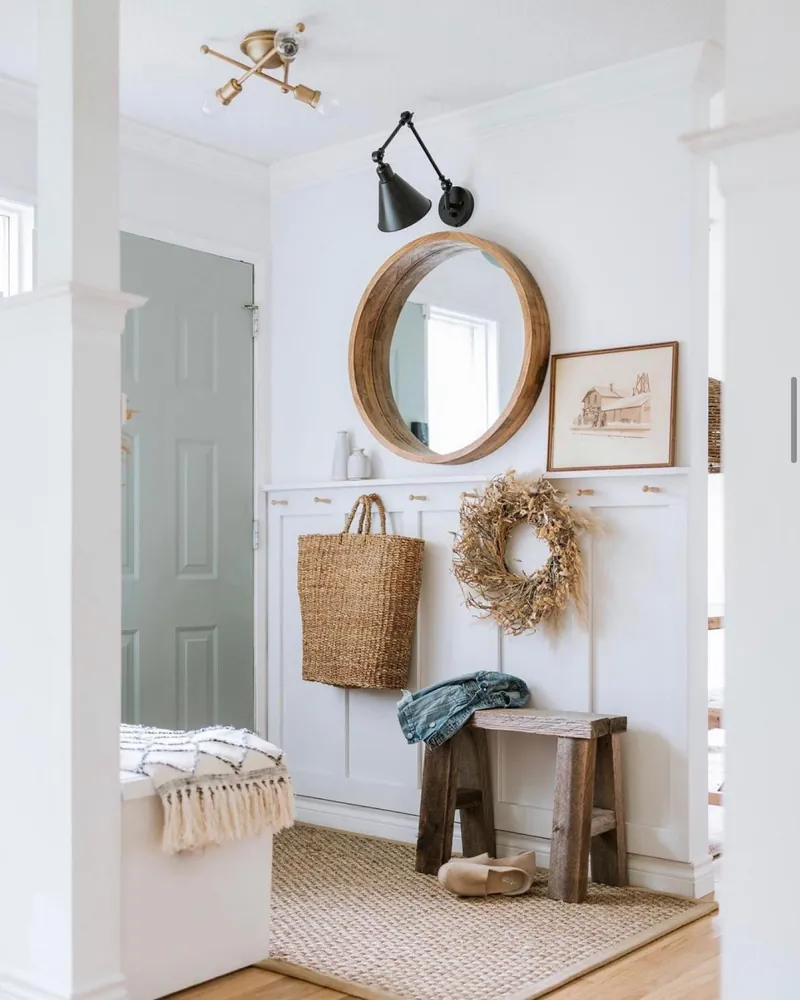
Lamps eat space. In a small entryway with no console at all, a wall sconce gives you light at night without needing a table to sit on.
In this bright white entry, a black swing-arm sconce reaches out over a deep round wood mirror. The arm pivots, so you can aim light at the hooks when you’re hunting for a bag, or at the mirror when you’re checking your face.
💡 Quick Tip
No wiring in that spot? Look for a plug-in sconce and run the cord down the wall inside a paintable cord cover. Renters can do this without an electrician.
Below the light, the paneled wall carries a slim ledge for a couple of small vases and a row of wooden pegs. A big seagrass tote hangs on one peg as a grab bag, and a little rustic stool gives you a seat for pulling on shoes.
7. Stack Three Storage Layers on One Shiplap Wall

Every inch of this little alcove has a job, from the floor right up past eye level.
The order is what makes it work. Daily things stay at arm height, shoes stay low where they land anyway, and the shelf holds what you rarely touch.
Hang the hooks high enough that a long coat clears the bench seat. Otherwise coats end up draped over whoever is sitting. A tough jute rug in front of the bench takes the grit before it reaches the rest of the house.
8. Choose a Leggy Bench So the Floor Stays in View

Heavy, boxy benches block the floor and make a narrow entry feel even tighter. Thin legs do the opposite.
The bench in this blush pink entry is a simple pale wood slab on slim black hairpin legs. You can see floor all the way to the wall, so the space reads larger. The open spot underneath still does real work, too. A round seagrass basket with leather handles slides in for shoes, hats, or the dog’s ball.
Paint handles the rest. The board-and-batten is soft pink below a white wall, and that color block marks the drop zone. Wooden pegs along the top rail hold a crossbody bag, a denim jacket, and a big tote of greenery.
A solid bench that sits flat on the floor. Dark shadow underneath, dust bunnies hiding behind it, and the hall looks shorter.
A slab on hairpin legs. Open floor below, one basket you can pull out, and a quick sweep reaches every corner.
9. Hang One Floating Shelf With Hooks Underneath

Barely any floor space by the door? Put the storage on the wall instead. A single thick wood shelf here holds a fern and dried grass on top, while a hook on the underside holds a fringed throw below.
To build your own version:
- Mount a sturdy wood shelf on strong brackets, into studs if you can find them.
- Screw two or three hooks into the bottom, close to the front edge so things hang clear of the wall.
- Center a big round mirror above the shelf.
- Tuck woven baskets on the floor below for shoes and bulky things.
A round woven rug and a small stool holding a plant finish the corner without crowding the walkway.
One shelf gives you a drop spot on top and hanging storage below, and the floor under it stays free for baskets.
10. Turn the Corner Beside the Door Into a Three-Hook Station
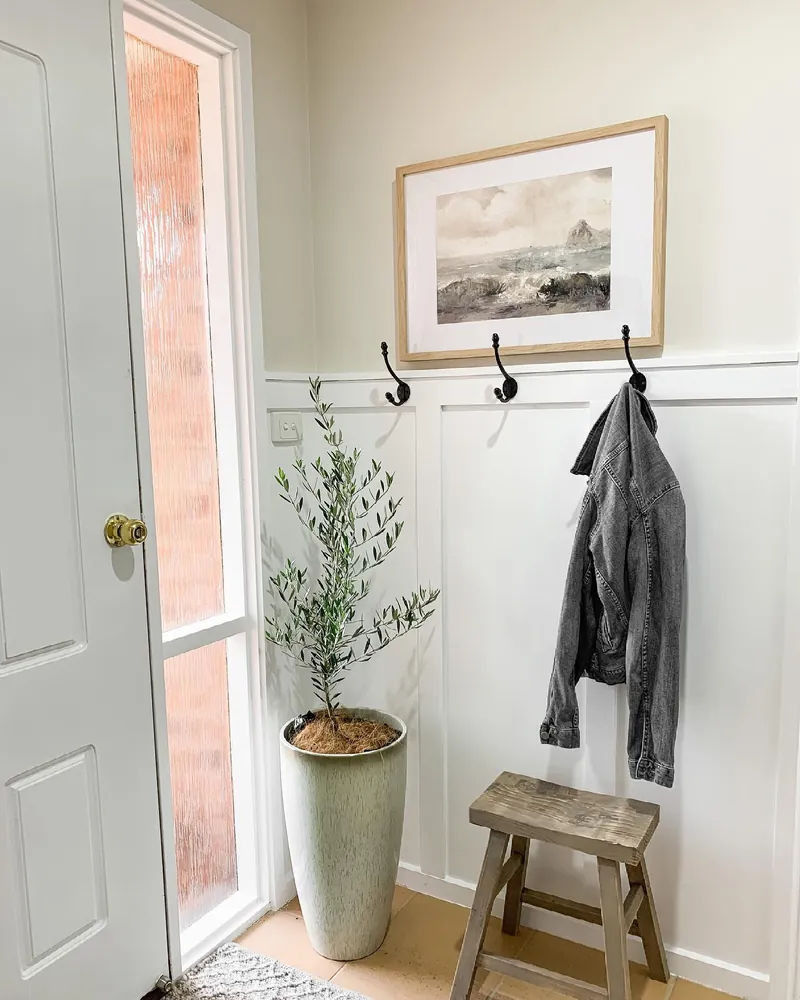
Some entryways are really just a door and a scrap of wall. That’s enough.
Three black double hooks sit along the top rail of white board-and-batten. A small wooden stool waits underneath for a bag, or for you while you tie your laces. A potted olive tree fills the awkward corner by the glass panel, so the space looks planned instead of empty.
The paneling helps more than you’d think. Its top rail gives the hooks a solid line to screw into, and painted panels shrug off bumps from bags better than plain drywall.
The three-hook corner kit
11. Give Every Person Their Own Basket Cubby

“Where are my gloves?” stops being a daily question once each person has a bin.
The long bench here has four open cubbies, each holding a woven basket. Black hooks on the vertical paneling take totes and coats, and the bench is long enough for two people to sit and pull on boots at once. A long runner on the dark tile catches dirt down the whole length.
| Basket | What goes inside |
|---|---|
| 🧑 Adult one | Gloves, sunglasses, work badge |
| 🧑 Adult two | Scarf, gym gear, earbuds |
| 🧒 Kid | Hat, mittens, library books |
| 🐕 Shared | Leash, dog bags, reusable shopping bags |
Tie a tag or a leather name patch to the front of each basket. Kids put things back when they know which bin is theirs.
12. Give Keys a Bowl and Clutter a Drawer

Calm-looking consoles still have a system behind them. On this dark wood one, the system is easy to copy.
On top: a wooden bowl on a stack of books. Keys go in the bowl every single time, so there’s only one place to look.
In the drawers: two shallow drawers take what you don’t want on display, like receipts, pens, and spare batteries.
On the lower shelf: a woven basket for gloves or a leash, balanced by a clay pot.
On the wall: a picture ledge holds the art, so the tabletop stays open for the bowl and a lamp. The lamp plus a small picture light give soft, warm light for coming home after dark.
Set the key bowl on the side closest to the door.
Empty the drawers once a month so they keep working.
An open tray for loose papers. It fills up fast.
Decor across the whole top with no landing space left.
13. Put a Small Key and Sunglasses Board Beside the Hooks
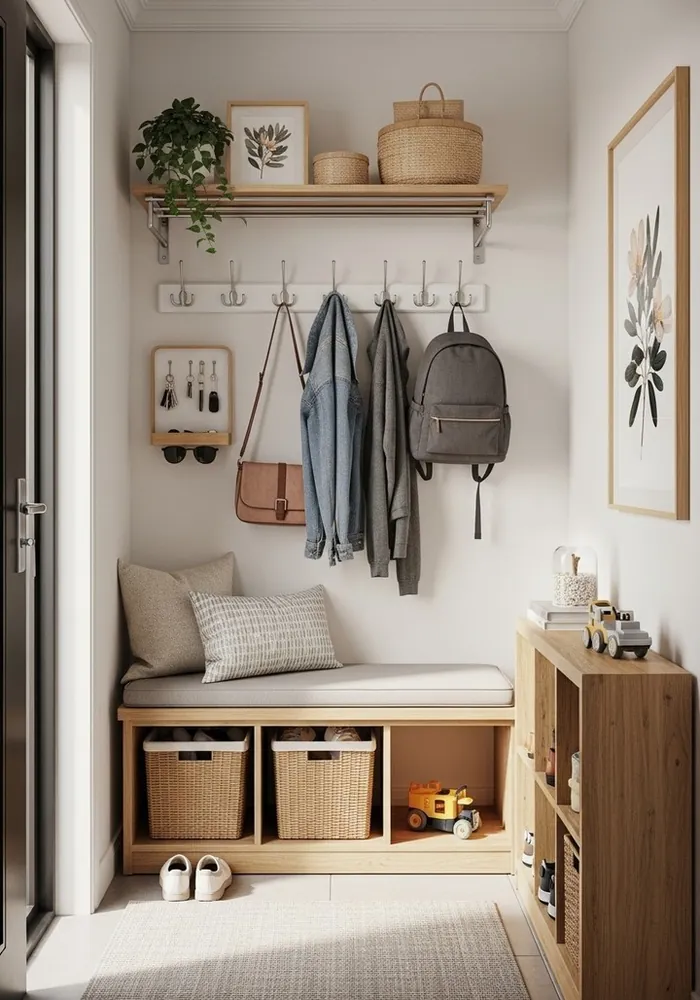
Keys and sunglasses are tiny, and tiny things vanish. This family nook solves it with a little wall board that has key hooks plus a mini ledge for sunglasses, hung right next to the coat hooks.
The rest of the nook backs it up. A cushioned bench has baskets below, a shelf above the hook strip holds lidded baskets, and an open cube unit on the side takes shoes and toys.
Hang the board at adult eye level, on the side of the hooks nearest the door.
Give each set of keys its own hook, car keys on the end.
Use the little ledge for sunglasses, earbuds, or a transit card.
Keep spare keys somewhere else. The board is for the ones you carry daily.
It costs very little and ends the morning key hunt for good.
14. Line a Long, Narrow Hallway From End to End

Long, skinny entries can feel like a tunnel. Here’s how this one turns the tunnel into a room:
- Slim console on the long wall. Shallow enough to walk past easily, with drawers, a lower shelf, a basket, and a brass lamp.
- Small bench on the end wall. The dead-end spot becomes a seat for pulling on boots.
- Runner down the middle. A patterned jute runner catches dirt and draws you into the space.
- One pattern on every wall. Wrapping the whole hall in green and gold wallpaper makes the tight space look on purpose.
Narrow halls tempt you to leave them bare. Lining them with slim pieces gives real storage and still leaves the walkway clear.
Bare walls, shoes lined up along the baseboard, one ceiling light, and nowhere to set down a bag.
Slim console with drawers, a bench at the far end, a runner underfoot, and warm lamp light.
15. Lift Shoes Off the Floor With a Wall-Mounted Rail
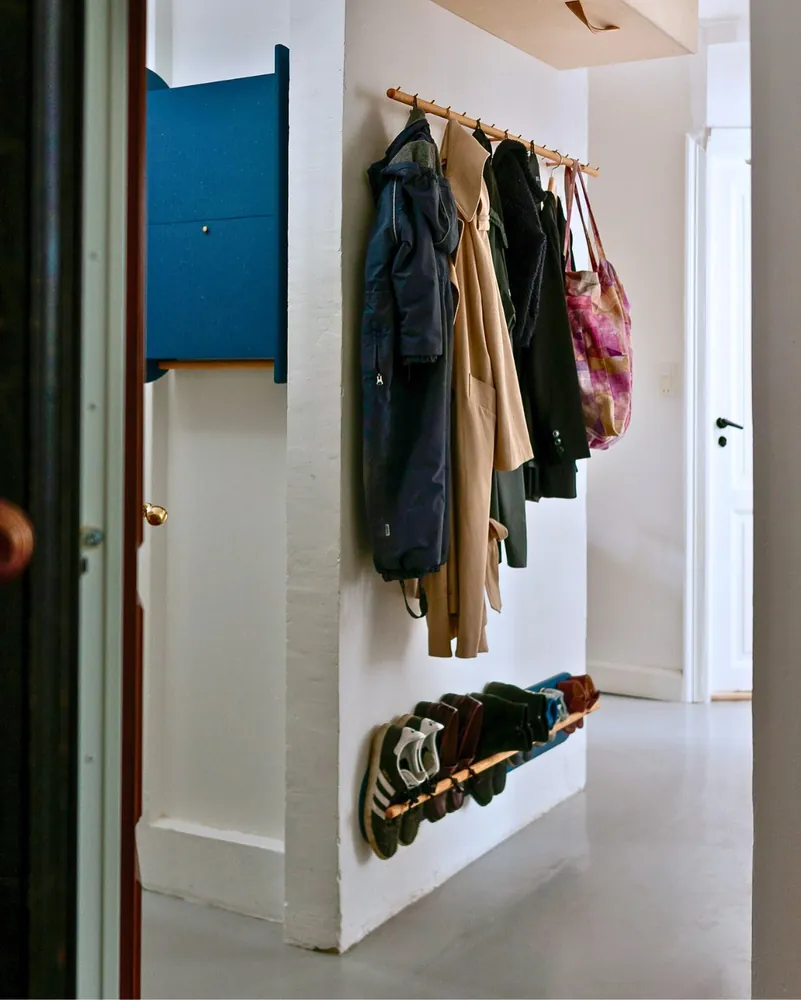
Floor space is the hardest thing to find in a small entry, so this one gives the floor back completely.
- A long wooden peg rail holds a whole household’s coats plus a tote bag.
- A slanted wooden shoe rail near the floor holds a row of sneakers and boots by their heels.
- A blue cabinet hung on the side wall takes the smaller stuff, with nothing touching the floor.
Mopping takes seconds, and you can spot every pair at a glance.
Mount the shoe rail low, but leave enough of a gap below it for a broom to pass.
16. Panel Just One Section of Wall to Mark the Drop Zone
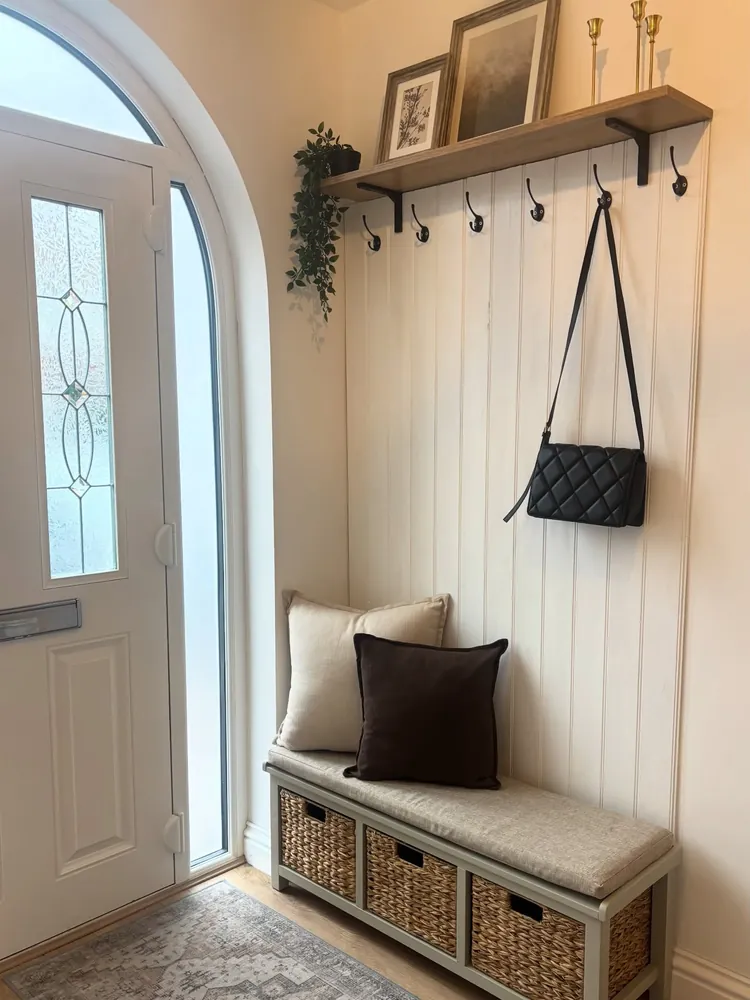
Paneling the whole entry isn’t necessary. In this entry with an arched front door, V-groove panels cover only the strip of wall above the bench, and that one section turns a plain wall into a clear “coats and bags go here” spot.
The setup is simple. A bench with a cushioned seat and three pull-out wicker baskets sits at the bottom. A row of black hooks runs across the panel. On top, a shelf on black brackets holds frames, brass candlesticks, and a trailing plant.
Shopping list for this look
Keep the panel the same width as the bench. That’s what makes the whole thing look built in.
17. Store Off-Season Gear in Baskets Up on the Shelf
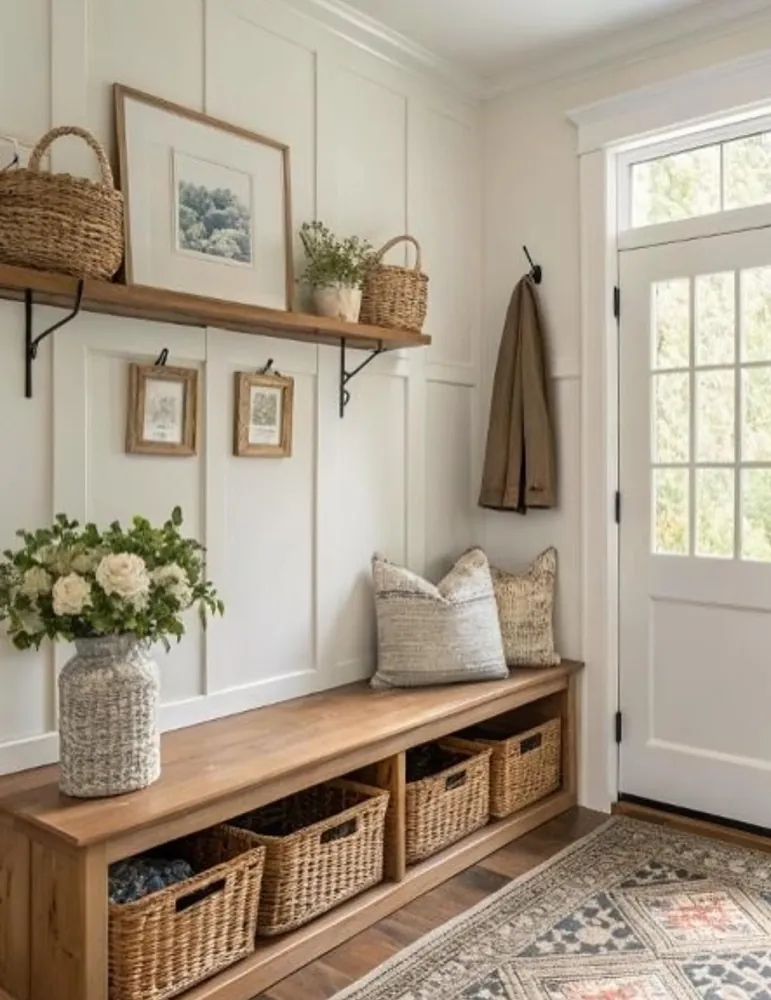
Winter hats don’t need prime space in July.
- The long wood bench has four baskets below for the things you use every week.
- A wood shelf on black iron brackets sits above it, holding two more baskets, a framed print, and a small plant.
- Those high baskets are the spot for off-season gear. It stays out of the way but is easy to reach with a step stool.
- One lone hook by the door takes the coat you grab most, so it never ends up buried under the others.
Swap what’s in the high and low baskets twice a year, and the bench never overflows.
18. Put a Low, Patterned Rug Right Where Muddy Shoes Land

The first few steps inside the door take the most dirt. The rug in this bright entry has a faded, vintage-style pattern laid over tile, and that busy design hides crumbs and scuffs between cleanings.
It also lies flat. The front door clears it as it swings open, and shoes can sit right on it to dry. Everything else stays lean, with a slim black metal bench, a wall hook rack holding a round rattan bag, and a big round woven mirror.
| Works well at the door | Struggles at the door |
|---|---|
| Low, flat pile | Thick shag that grabs grit |
| Faded or busy pattern | Solid pale color |
| Light enough to shake out or wash | Heavy rug that needs pro cleaning |
| Non-slip pad underneath | Loose rug on slick tile |
Go washable if you can. You’ll thank yourself after the first rainy week.
19. Use the Back of the Front Door for Bulky Gear

In an apartment hallway, the door itself is wall space most people waste. Here, a folded stroller hangs from the inside of the front door, so it never blocks the hall.
The rest of this entry squeezes into one side wall:
- A slim white tip-out shoe cabinet with a wood top for a cup or keys.
- Two white shelves on wood brackets above it for a plant and small things.
- A short peg rail low on the wall by the door, holding kids’ jackets at their height.
- A big wall calendar, so the week’s plans are the last thing you see on the way out.
⚠️ Watch Out
Check that the door still closes and locks easily with the hook in place. Hollow doors can’t take much weight, so keep heavy gear on a solid door.
Make Your Small Entry Work Hard
The small entries that work best all share one habit. Every piece by the door has a job, whether it’s a hook where your hand already reaches, a basket that swallows the gloves, or a shelf that keeps the floor clear.
Start with the problem that bugs you most. Shoes everywhere? Look at the tip-out cabinet or the wall shoe rail. Keys always missing? The bowl and drawer setup or the little key board will fix that fast. Once the first change sticks, add one more.
Save these small entryway ideas to your home board so they’re ready the next time the pile by the door starts growing.