
Furniture Layout Planner
Enter your room dimensions and get an optimised furniture arrangement with spacing guides
Room Dimensions
Measure your room from wall to wall, not including skirting boards
Room Type
Select the primary use of this room
Furniture to Include
Select all pieces you plan to fit in this room
Special Features
Does your room have any of these? (affects layout recommendations)
Layout Diagram
Approximate to-scale plan — not architectural, for planning purposes only
Clearance Check
Minimum recommended walkway and clearance spacings
Layout Recommendations
Tailored tips based on your room and furniture selection
How to Plan Your Furniture Layout Before You Move a Single Thing
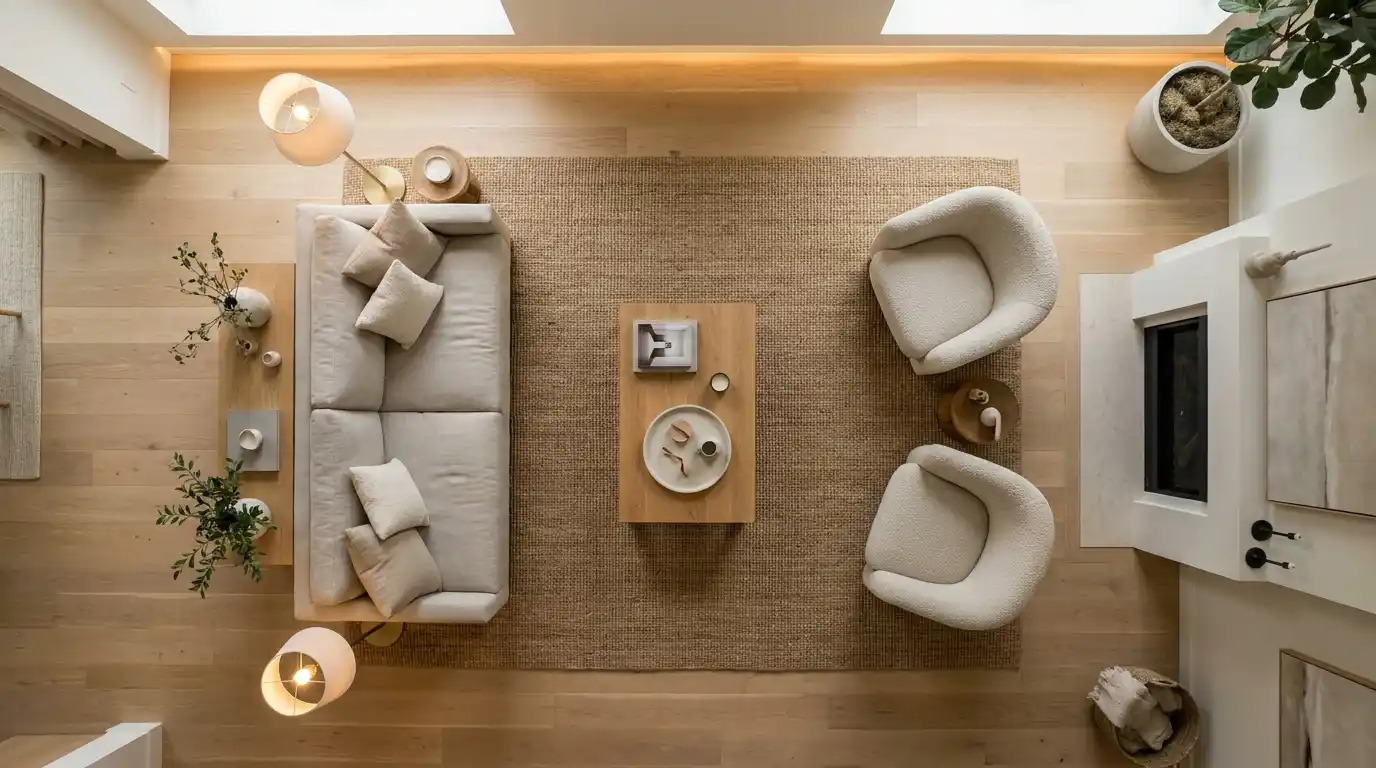
Most people approach furniture arrangement the same way — they drag a heavy sofa across the room, stand back, decide it doesn’t work, and drag it somewhere else. It’s exhausting, it scuffs the floors, and it rarely leads to the best result. There’s a better way, and it starts long before you touch a single piece of furniture.
Why Layout Planning Matters More Than You Think
A well-arranged room isn’t just about aesthetics. It affects how comfortable the space feels to live in, how easily you can move through it, and whether the room actually serves its purpose. A bedroom where you have to squeeze sideways past the wardrobe every morning creates low-level frustration that adds up over time. A living room where the sofa is too far from the coffee table, or too close to the TV, just never quite feels right — even if you can’t pinpoint why.
The good news is that furniture planning is a learnable skill, and most of the principles are straightforward once you know them.
Start With Accurate Measurements
Before anything else, measure your room. This sounds obvious, but a surprising number of people skip it or guess. Measure wall to wall at floor level, not at skirting board height, and note the position of doors, windows, and any fixed features like radiators or alcoves.
Then measure your existing furniture — or look up the dimensions of pieces you’re planning to buy. A standard three-seater sofa is roughly 220 cm wide and 90 cm deep. A king-size bed is about 193 cm × 213 cm. These numbers matter a great deal in a room that’s only 3.5 metres across.
Understand the Clearance Rules
Interior designers follow a set of minimum clearance guidelines that exist for practical reasons. The main ones to know:
Walkways should be at least 90 cm wide — enough for two people to pass comfortably. In tighter spaces, 75 cm is the absolute minimum for a single-person corridor.
Sofa to coffee table works best at 35–45 cm. Close enough to reach your drink without stretching, far enough that you’re not constantly knocking your shins.
Bed surrounds need at least 60 cm on the sides you’ll actually use — more if two people need access independently. In front of a wardrobe, allow 90 cm minimum for the door swing and dressing space.
Dining table to wall should be at least 90 cm, ideally 120 cm, so chairs can be pulled out and people can walk behind seated guests without awkwardness.
The Furniture-to-Floor Ratio
One of the most useful concepts in room planning is the furniture-to-floor ratio — the percentage of your floor area that’s actually covered by furniture footprints. Most interior designers suggest keeping this under 40–50% for a room that feels open and comfortable.
Go much above 50% and the room starts to feel crowded, even if every individual piece is the right size. Drop below 20% and the room can feel sparse and echoey, like a hotel lobby that hasn’t been finished yet.
If you find your chosen pieces push you over the 50% threshold, it’s worth asking which items earn their place. A floor lamp takes very little room but adds a lot. A second armchair might be less essential than it seems.
Work With the Room’s Natural Focal Point
Every room has a natural focal point — a fireplace, a large window, a TV wall, or simply the longest uninterrupted wall. Good furniture arrangements work with that focal point rather than against it.
In a living room, arrange seating so it faces the focal point, ideally in an L-shape or U-shape that encourages conversation. In a bedroom, the bed typically anchors the room best when positioned on the wall facing the door — so it’s the first thing you see when you walk in. In a dining room, the table should sit roughly centred under any overhead light fitting.
If your room has a bay window or strong natural light source, resist the instinct to block it. Position furniture to frame the view rather than obscure it.
Use a Planning Tool Before Moving Anything
The smartest thing you can do before rearranging — or buying — furniture is to map it out digitally first. The Furniture Layout Planner lets you enter your exact room dimensions in feet, metres, or centimetres, then select the pieces you’re working with across room types including living rooms, bedrooms, dining rooms, home offices, nurseries, and studio flats.
The tool generates a scaled floor plan, automatically checks your clearances, calculates your furniture-to-floor ratio, and gives you tailored layout recommendations based on your specific combination of room size, room type, and furniture selection. If you’ve got a fireplace or a feature window, you can flag those too — the advice adjusts accordingly.
It takes about two minutes to run, and it can save hours of physical trial and error.
The Painter’s Tape Test
Once you’ve settled on a layout digitally, there’s one final step worth taking before the heavy lifting begins: mark it out with painter’s tape on the floor. Tape the exact footprint of each piece of furniture in its planned position, then live with it for a day or two.
Walk through the space. Try sitting in the spots where your sofa and chairs would be. Open the wardrobe doors. Pull out the dining chairs. You’ll immediately discover whether the flow works in practice — and it’s infinitely easier to reposition a strip of tape than a solid oak sideboard.
Final Thought
Good furniture arrangement is mostly about restraint and spatial awareness — knowing what to leave out, respecting the clearances, and letting the room breathe. Plan it properly once, and you’ll rarely need to revisit it.