
Where to Put a Christmas Tree in a Small Apartment Without Losing Your Walkway

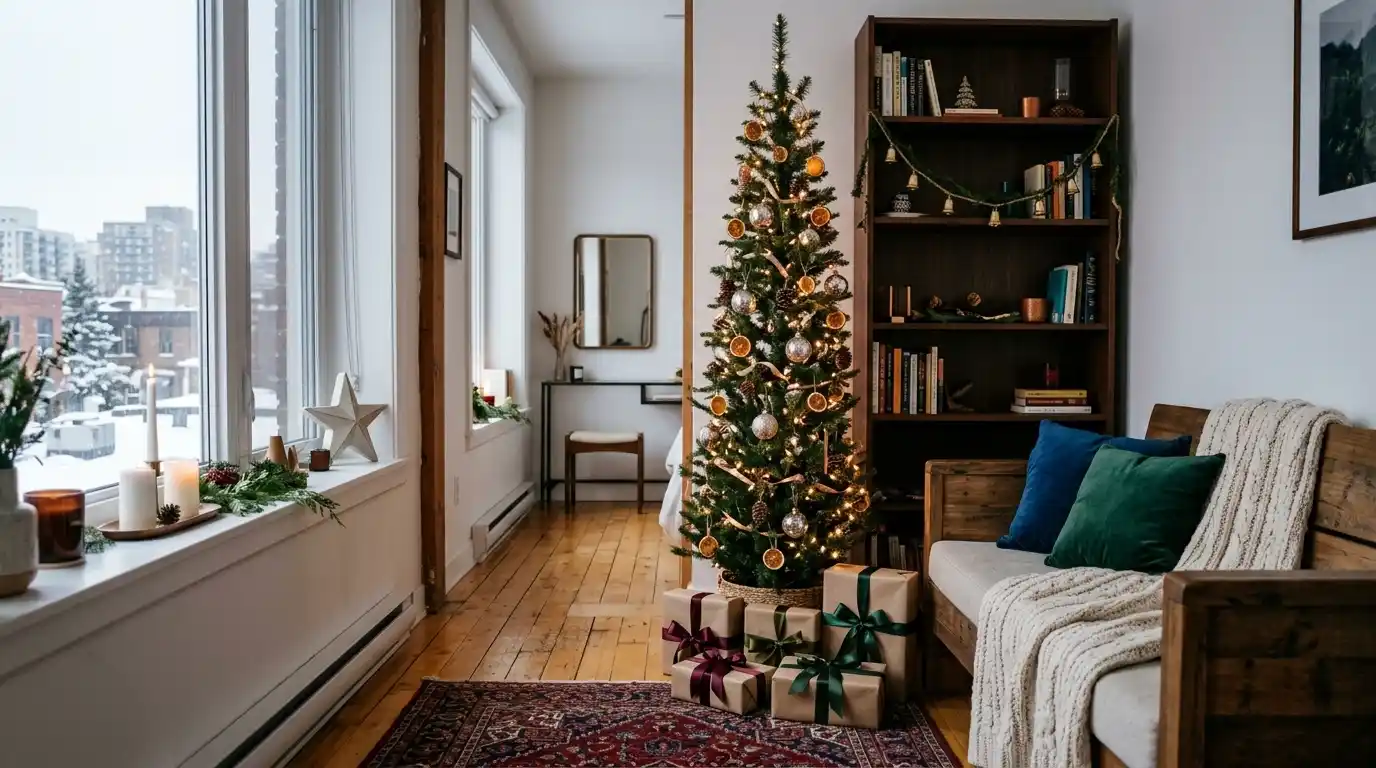
A full 7.5-foot Christmas tree is often about 5 feet wide at the bottom. That’s close to 20 square feet of floor gone, which is why figuring out where to put a Christmas tree in a small apartment starts with width, not height. In a tight living room, that can be the whole space between your couch and your TV.
I learned this the hard way in my first one-bedroom. I bought the tree first and looked for a spot second. It ended up wedged next to the radiator, dropping needles by mid-December, with a light cord stretched across the doorway that I tripped over twice a day.
This guide does it in the opposite order. You’ll rule out the spots that won’t work, test the one that might, and only then pick a tree that fits it. By the end, you’ll have a spot that is safe, close to power, out of your walking path, and tested by real life for a full day.
The hands-on part takes about 45 minutes. The tape test asks you to wait 24 hours before you buy anything. That one day of waiting keeps the tree from becoming the thing you squeeze past and resent all month.
Grab These Before You Measure
Most of this is already in a kitchen drawer. The last few items are for setup day.
- 25-foot tape measure
- Blue painter’s tape (1-inch roll)
- Phone or notepad for your numbers
- Flashlight, to find hidden outlets
- Step stool, to reach the ceiling
- Plant saucer or boot tray, 2 inches wider than the stand
- Clear fishing line (20 lb strength)
- One removable adhesive wall hook
- Safety-certified indoor extension cord (only if needed)
- Tree skirt or tree collar
All 9 Moves on One Screen
- Map outlets within 6 feet of open wall
- Cross off spots within 3 feet of heat
- Trace door swings and keep 36 inches clear
- Move one bulky chair out for December
- Tape the tree’s footprint and live with it 24 hours
- Subtract 12 inches from ceiling height
- Match the tree shape to your tape circle
- Set a waterproof tray under the stand
- Anchor the trunk to the wall
Map every outlet within 6 feet of an open wall

Without an outlet close by, the best-looking corner in your home becomes a cord problem. Tree lights need power, and a cord stretched across the floor is the first thing a guest, or you at 2 a.m., will trip over.
Grab a flashlight and walk through every room you’d consider. Check behind the couch, under the TV stand and beside the bed. Outlets hide in the places we stop looking.
Stick a small piece of painter’s tape on the wall above each outlet you find. Then look at the wall on either side. You need at least 3 feet of open wall within 6 feet of that outlet for the spot to stay on your list. That way the light cord reaches without stretching or running under a rug, where it can overheat.
While you’re there, flip the nearby light switches. Some outlets turn on and off with a wall switch. If you find one, draw a star on that tape. It lets you turn the tree on from the doorway every evening.
Cross off any spot closer than 3 feet to a radiator, heater or stove

Three feet is the gap fire safety groups recommend between a tree and anything that gives off heat. In a small apartment, that rule crosses off more spots than you’d expect.
Measure 3 feet out from each of these and lay a strip of tape on the floor:
- Radiators and baseboard heaters
- Heating vents in the floor or low on the wall
- Space heaters, even ones you only use at night
- The stove and oven, if your living area opens to the kitchen
- A fireplace, or candles you light often
Check under your windows too. In many older buildings, the radiator sits right below the window you were hoping to use.
Any outlet tape from the last step that now sits inside one of these lines is out. Peel it off.
Radiators Dry Trees Faster Than You Think
A fresh real tree can drink about 1 quart of water per inch of trunk width every day. Next to a heat source it dries out much faster, drops needles early, and catches fire far more easily than a well-watered tree. For an artificial tree, check the box for a “fire resistant” label.
Trace your door swings and keep a 36-inch walking path open

A tree that blocks a door is a tree you’ll end up moving twice. Before you fall for a corner, open every door in the room all the way: the front door, closet, bathroom and balcony.
Watch where each door sweeps. Lay a piece of tape on the floor where the edge of the door stops. No part of the tree, not a branch and not the stand, should sit inside that arc. Branches catch on doors, and every bump shakes loose needles and ornaments.
Next, find your main walking path. This is the line you take from the front door to the couch, the kitchen and the bedroom. Hold your tape measure across it. Aim for 36 inches of clear space, about the width of a standard doorway. If your room is very tight, 30 inches is the smallest gap most people can pass through without turning sideways.
Measure from the edge of the furniture, not from the wall. A couch arm or the corner of a coffee table is what actually narrows the path.
Relocate one bulky chair to the bedroom for December
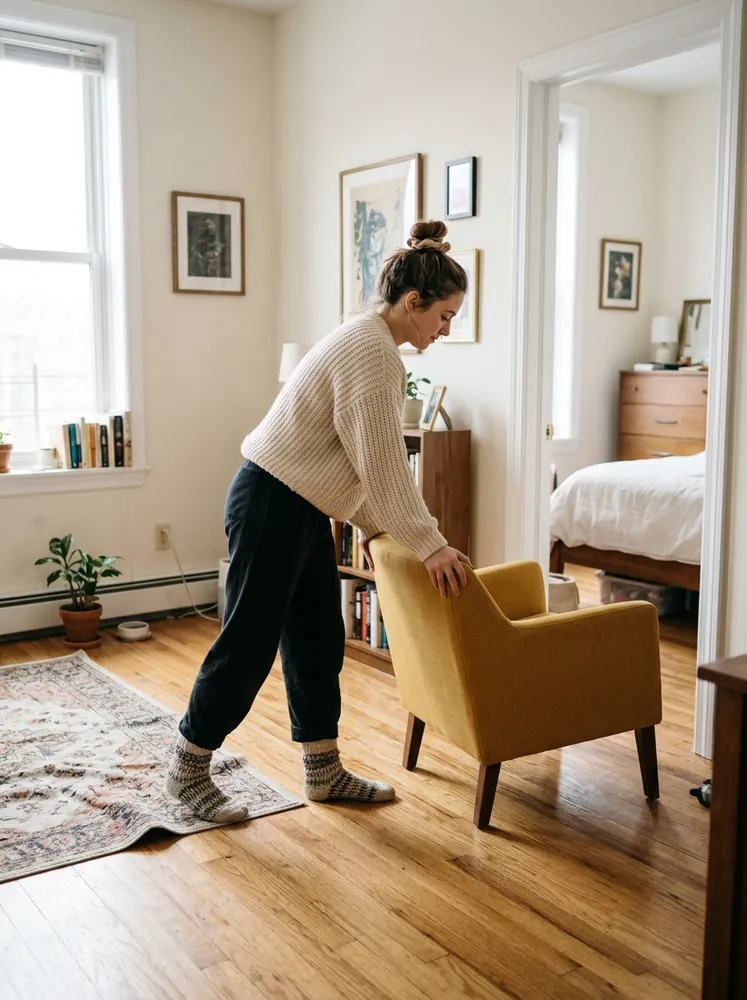
Your living room probably has one piece of furniture that’s there out of habit, not need. For four weeks, that piece can go somewhere else, and its corner can hold the tree.
Look for anything that takes up about 3 feet by 3 feet of floor:
- An armchair nobody really sits in
- An ottoman or pouf
- A side table or plant stand
- A floor lamp (the tree lights will replace its glow)
Move it to the bedroom, slide it into a closet, or tuck it under a bed. Then check the empty space against the tape lines from your first three steps. It needs an outlet nearby, no heat within 3 feet, and no door swing or walking path running through it.
A swap like this sounds like a big change, but you’ll barely notice the chair is gone. Come January, it goes straight back.
Test where to put a Christmas tree in a small apartment with painter’s tape
How big is a tree, really, once it’s standing in your room? We almost always guess too small, because we see trees in stores and lots with open space all around them.
Pick the spot that survived your tape lines. Decide the widest tree you think you could live with there, for example 36 inches. Stick a small piece of tape where the trunk would stand. Hold the end of your tape measure on it, swing the tape around at 18 inches, and press a short strip of tape to the floor every few inches. That gives you a circle 36 inches across.
Leave the circle down for 24 hours. Walk past it carrying laundry. Open the doors near it. Vacuum around it. Sit down and watch TV.
If you keep stepping on the tape, the circle is too big. Pull it in by 4 to 6 inches and test again. If nothing bumped it all day, write down the width. That number is your shopping limit.
Sit on the Couch Before You Decide
Look at the tape circle from your favorite seat, then from the front door. The best spot is one you can see from the couch without it blocking the TV, and one you don’t bump into the second you walk in.
Subtract 12 inches from your ceiling height before you shop
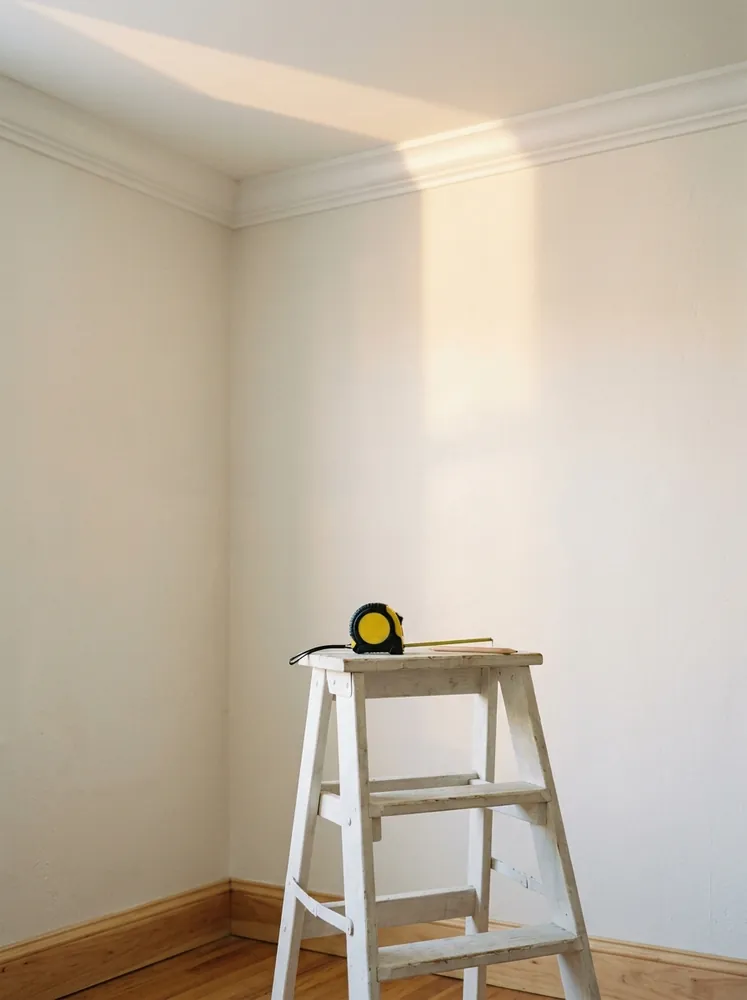
With an 8-foot ceiling, a 7.5-foot tree sounds like it should fit. It usually doesn’t, because the stand and the topper both add height.
Climb your step stool and measure from the floor to the ceiling right above your tape circle. Older apartments often have beams, bulkheads or sloped ceilings, so measure where the tree will stand, not in the middle of the room.
Take 12 inches off that number. This covers the stand, which lifts the tree a few inches, the star or topper, which often adds 6 to 10 inches, and a small gap so the topper doesn’t scrape the ceiling.
- 8-foot ceiling: tree no taller than 7 feet
- 9-foot ceiling: tree no taller than 8 feet
Keep in mind that height and width grow together. A taller tree almost always has a wider bottom. In a small room, a tree one size below your limit often fits your tape circle much better.
Match the tree shape to your tape circle if it’s narrower than 3 feet
Your tape circle decides this, not the tree lot. Read the width you wrote down, then follow the line that matches it.
If your circle is 32 to 40 inches, look for a slim tree. Many are about 30 to 40 inches wide at 7 feet tall and still look full.
If it’s 24 to 30 inches, go for a pencil tree. These run about 20 to 30 inches wide and fit beside a sofa or in a narrow corner.
If your spot is against a wall with very little depth, try a flat-back tree, sometimes called a half tree. It has branches on one side only, sits flush to the wall, and takes about half the floor.
If you have less than 24 inches, skip the floor. A 2- to 4-foot tabletop tree on a sturdy console or dresser gives you the same glow.
Words like “slim” mean different sizes at different brands, so always check the listed diameter. At a real-tree lot, ask the staff to unwrap the tree and shake it out. Netted branches spread wider over the first day.
Slide a waterproof tray under the stand to protect rental floors

A month of small drips on a wood floor can leave a gray ring that costs you part of your deposit. A real tree’s stand gets topped up every day, and a few drops each time add up.
Before the tree goes in:
- Set a plant saucer or boot tray, at least 2 inches wider than the stand, in the center of your tape circle
- On carpet, lay a sheet of plastic under the tray first
- Stick felt pads under the feet of an artificial tree’s metal stand so it can’t scratch
- Place the stand in the tray
Refill with a watering can that has a long spout. It reaches under low branches without splashing. Your tree skirt will hide the tray completely.
Anchor the trunk to the wall with fishing line and a removable hook
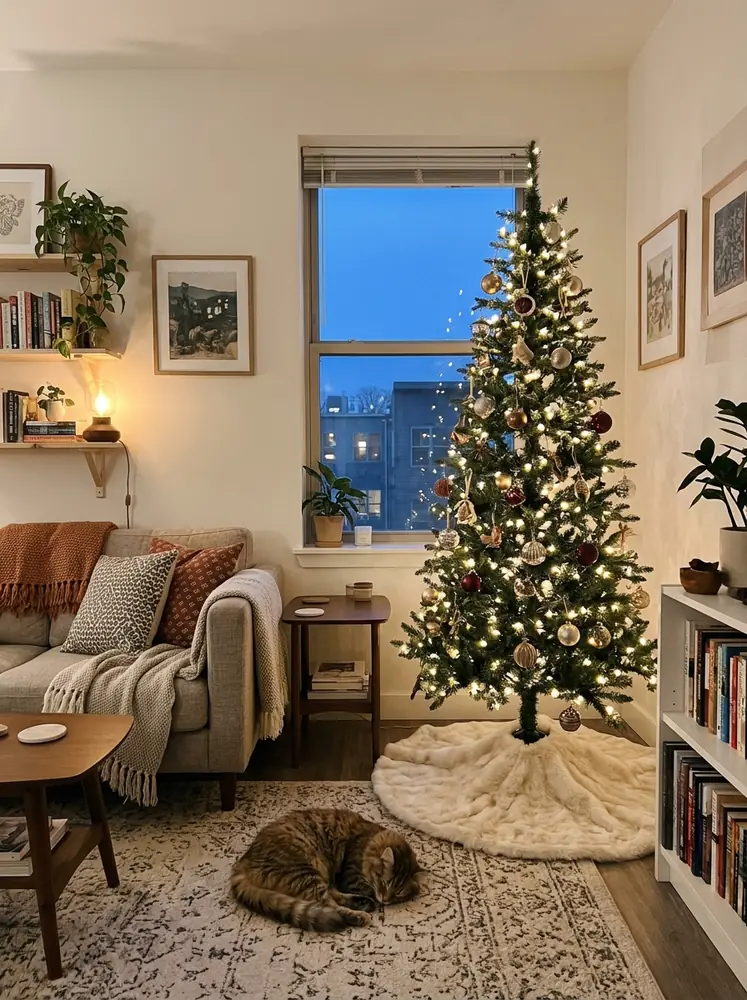
One playful cat or one excited toddler is all it takes. Slim and pencil trees have small bases, so they tip more easily than wide ones, and in a small room they sit closer to all the action.
Pick a spot on the wall behind the tree, about two-thirds of the way up, where branches will hide it. Wipe the wall with a dry cloth and press a removable adhesive hook there for 30 seconds. Most hooks need about 1 hour before they can hold anything, so do this before you decorate.
Tie clear fishing line around the trunk, not a branch, at the same height. Branches bend, but the trunk won’t. Loop the line through the hook and pull it snug, not tight. The line isn’t holding the tree up. It only stops the tree from falling forward.
No wall behind your tree? Tie the line to a heavy bookshelf or a curtain-rod bracket instead.
Give the trunk a gentle push. It should rock slightly and settle back.
When the Spot Fights Back
Small-space problems that show up after the tree is in, and how to fix them without starting over.
Small-Space Tree Questions Readers Send Us
Can I put my tree in front of a window?
Yes, as long as there’s no radiator or heating vent under the window and the tree stays 3 feet from any heat. People outside will see your lights, too. For a real tree, close the blinds during strong afternoon sun so it doesn’t dry out faster.
Is a real tree even allowed in my apartment?
Some buildings don’t allow real trees because of fire rules. Check your lease or ask building management before you buy. If real trees aren’t allowed, a pencil or flat-back artificial tree fits the same tested spot.
Is a corner better than the middle of a wall?
A corner usually wins in a small room. Two walls hide the back of the tree, and it uses floor you weren’t using anyway. The middle of a wall works best for a flat-back tree.
Can the tree go on my balcony?
It can, if your building allows it. Use lights and cords marked for outdoor use, and anchor the tree to the railing, because wind tips trees much faster than pets do.
What if my tape test leaves no floor space at all?
Go up instead of out. Set a small tabletop tree on a dresser or bookshelf, or make a wall tree by shaping string lights or garland into a triangle with removable clips. Both give you the glow without touching the floor.
Keep the Tape Down Until the Tree Is Home
You now have a spot that’s close to power, clear of heat, out of every door’s path, and tested by a full day of real life.
If you remember one thing from this guide, make it the tape circle. 24 hours of stepping around blue tape tells you more about where to put a Christmas tree in a small apartment than any store display can.
Once the tree is standing and anchored, the fun part starts: wrap the lights first, beginning at the trunk and working your way out to the tips.
Save this pin to your holiday board so it’s ready when you’re standing in your living room with a tape measure next weekend.