
Curtain & Blind Size Calculator
Get the exact finished size, fabric quantity, and fitting guide for any window treatment
Your Curtain Measurements
| Measurement | Value | Notes |
|---|
How to Get Curtain and Blind Sizes Right the First Time
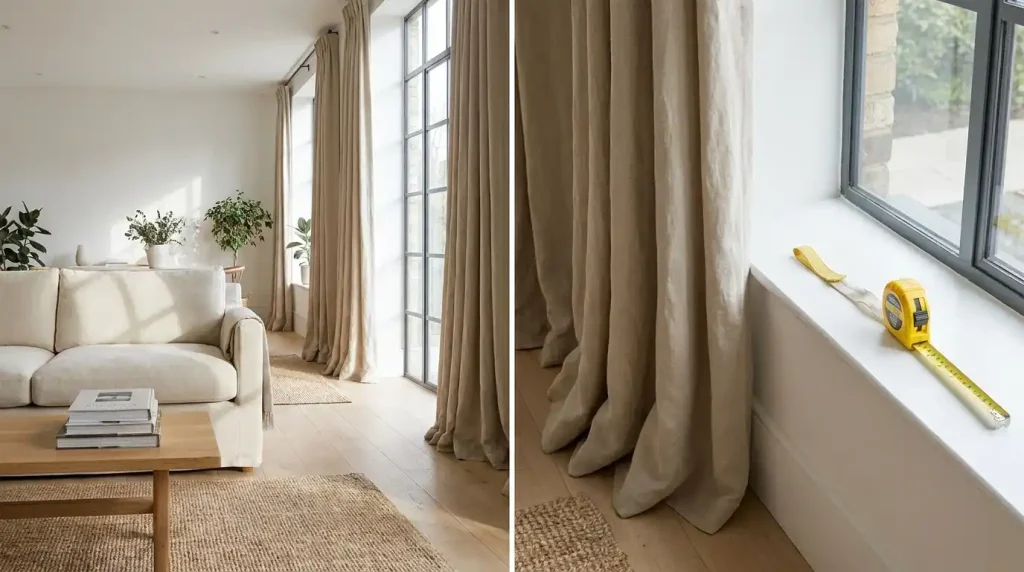
Hanging new curtains or fitting a blind sounds simple enough — until you realise you've cut the fabric too short, or the roller blind binds inside the recess because you measured at only one point. Getting window treatments right the first time saves money, time, and a fair amount of frustration. That's exactly what a dedicated curtain and blind size calculator is built to help with.
Why Measuring a Window Isn't as Simple as It Looks
A window opening is just one of many measurements that matter. Where you hang the track, how high above the glass, whether the treatment sits inside the frame or face-mounts on the wall — all of these shift your final dimensions considerably.
Take drop length, for example. A curtain hung 15 cm above the window and styled to puddle on the floor will need a completely different cut length than one that finishes just at the sill. Get that wrong and you're either hemming already-finished panels or living with curtains that hover awkwardly above the floor.
The same goes for width. Face-fitted curtains need stack-back allowance — typically 15 cm each side — so the fabric clears the glass when pulled open. Without that, your curtains spend half their life blocking the window they're supposed to frame.
What the Calculator Actually Does
Rather than leaving you to juggle all these variables manually, the calculator walks through each decision in sequence and handles the arithmetic behind the scenes.
You start with your raw window measurements — the actual opening, not a guess — and choose your units. Whether you work in centimetres, millimetres, inches, or metres, the tool adjusts every output accordingly.
From there, you pick your treatment type. The eight options cover the most common styles:
- Pencil pleat — the classic gathered look, usually requiring 2–2.5× the track width in fabric
- Eyelet / ring top — a more relaxed, modern style that uses slightly less fabric
- Pinch pleat — formal and tailored, best for high ceilings and elegant rooms
- Tab top — casual and unfussy, with fabric tabs looping directly over the pole
- Roman blind — clean horizontal folds, measured flat with no fullness ratio
- Roller blind — minimal and practical, cut to a precise width
- Venetian blind — adjustable louvres, where the narrowest recess measurement always wins
- Voile / sheer — light-filtering panels, often layered and using 3× the width for a full, airy effect
Each type has different measurement logic, and the calculator switches its rules accordingly. Blind types, for instance, don't ask for fullness ratios or heading allowances — those inputs simply don't apply.
Fitting Style Changes Everything
One of the most useful parts of the tool is how it handles the face fit versus recess fit distinction. This single choice affects your finished width calculation more than almost anything else.
For recess fit blinds, the calculator deducts a small clearance — typically 2–3 cm — from your measured opening so the blind can travel without binding against the frame. For a face fit on curtains, it adds 30 cm to the opening (15 cm per side) to account for the fabric stacking back when the curtains are open.
For floor-length drops, you'll also enter the floor-to-sill measurement, which lets the calculator work out an accurate finished drop regardless of whether you want a clean 1.5 cm clearance, a classic break at 12 cm below the sill, or a deliberate puddle.
Cut Sizes vs. Finished Sizes
One thing that trips up a lot of first-time makers is the difference between a finished measurement and a cut measurement. The finished width and drop are what the curtain looks like hanging in place. But the fabric needs to be cut larger to allow for hems, headings, and seams.
The calculator outputs both. The cut width per panel already includes the side seam allowances. The cut drop adds your chosen heading allowance (typically 15 cm, folded above the heading tape) and hem allowance (usually 20 cm for a proper double-turn hem at the base). These are adjustable if your workroom uses different standards.
The Fabric Section Saves Real Money
If you enter your fabric roll width and any pattern repeat, the calculator goes a step further — it works out exactly how many fabric widths you need per panel, how many widths to cut in total across all windows, and your overall meterage including a sensible 10% buffer.
Pattern repeats are where people most often underorder. A 30 cm repeat on a curtain that needs a 240 cm cut length means you're not cutting 240 cm — you're cutting to the next full repeat above that, and every width wastes a bit at the top or bottom. The calculator accounts for this automatically.
Lining is included too. If you're adding standard, blackout, or interlined lining, the tool estimates that requirement alongside your face fabric.
A Diagram and a Tip Sheet
Once you hit calculate, the results include a visual diagram showing the window, track position, panel layout, and annotated dimensions. It's a proportional sketch rather than a technical drawing, but it's genuinely useful for double-checking that the drop style and panel count look right before you commit to cutting.
The fitting tips section rounds things off with advice specific to your chosen type and setup — things like measuring your recess at three points for a venetian blind, or why blackout lining needs side returns to be truly effective.
One Rule That Always Applies
Whatever treatment you're making or ordering, always remeasure before you cut. Walls aren't always square, floors aren't always level, and even a window measured carefully twice can reveal a discrepancy the third time. Use the calculator to understand exactly what you're aiming for — then confirm every dimension against your actual wall before anything is cut or ordered.
Get the numbers right once, and everything else follows.